Some trucking companies are regulated by the federal government. Others by provincial legislation. And while many of the basic workplace rules are similar, there are some significant differences you should be aware of, particularly when it comes to severance, benefits, statutory holidays, and other employment entitlements.
In most cases, a workplace will be governed by provincial legislation as only about 6% of employees in Canada are federally regulated. However, when it comes to trucking, that percentage goes up.
So how do you know?
Well, one rule of thumb is whether the road transportation services you provide, including trucks and buses, cross provincial, or international borders. If so- you are likely federally regulated, and that means there can be a difference in the workplace and employments laws that regulate your company compared to your provincial counterparts.
In general, the following industries and workplaces are federally regulated:
Air transport
Broadcasting
Chartered banks
Federal Crown corporations
Federal government employees
Feed and feed mills
Grain elevators
Interprovincial pipelines
Interprovincial trucking
Rail and water transport
Work directly for or on behalf of First Nations
Federally regulated employees are governed by the Canada Labour Code, while provincially regulated employees are governed by the Employment Standards legislation in the province in which they are employed. If in doubt, seek legal counsel.
This is a timely discussion to have, as the federal government recently passed legislation to make September 30th a federal statutory holiday called the “National Day for Truth and Reconciliation”.
If you are a federally regulated business- you must honour this statutory holiday by closing and paying general stat pay, or staying open and paying overtime wages, where applicable. If you are provincially regulated, then you are not required to observe this stat at this time.
Unionized employers are advised to consult legal counsel to determine the applicability of this stat as it relates to their collective agreement.
First and foremost I once again want to Thank You (Shelley Uvanile-Hesch), The Women’s Trucking Federation of Canada, your member’s and CHET!!!!
I am Absolutely having the time of my life!!!!
I have Never Loved a Job Like I Love My Trucking Career!!! Everyday I Look forward to and can’t wait to get to work!! I can’t believe I get paid to do something I Love So Much! Being in My Truck Out on the Road Truly is My Happy place, and I’m always smiling from ear to ear!!! I am very lucky as I got a job rather quickly after I completed school and passing my road test on the first shot with only 2 demerits which is something I am very proud of myself for accomplishing! I am currently working for Contrans Tank Division Hauling Chocolate!!! When I first heard they wanted me to haul tanker I wasn’t too excited about that as I wanted to haul flatbed, but I gave it a shot and I Love It, I can’t imagine hauling any other type of trailer! My dispatcher keeps me very busy; I work a lot of hours and endless days but it doesn’t bother me at all, I Love Being Out There! I’ve learned a lot of things along the way as this job never stops teaching me something new everyday and I’ve met so many other drivers, all of which are very helpful and so welcoming to me into the trucking world!!
I can’t express how Thankful I Am To You All for Awarding me the Scholarship last year, for believing in me and having faith that I would take this gift and run with it, which I certainly have! Because of your belief in my abilities I am fulfilling my dreams, and if it wasn’t for your generous gift I wouldn’t be living my dream… I’d still be living with a dream trying to figure out how to make it happen and that means so much to me! So Thank You!
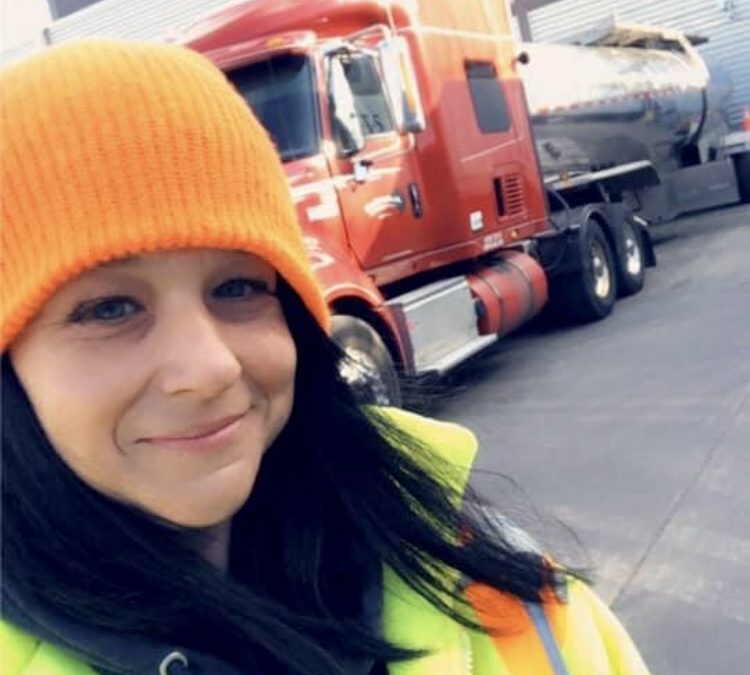
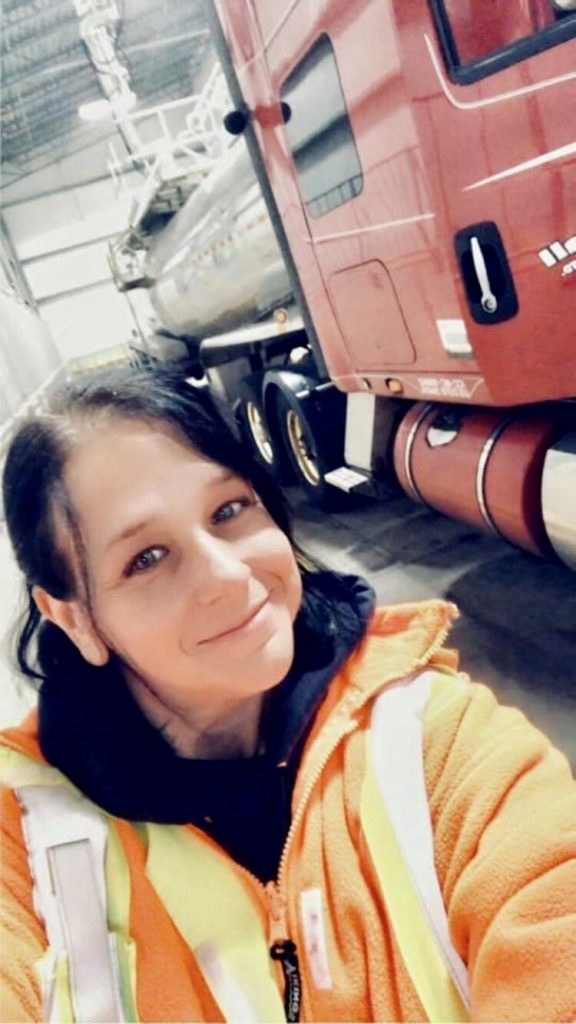
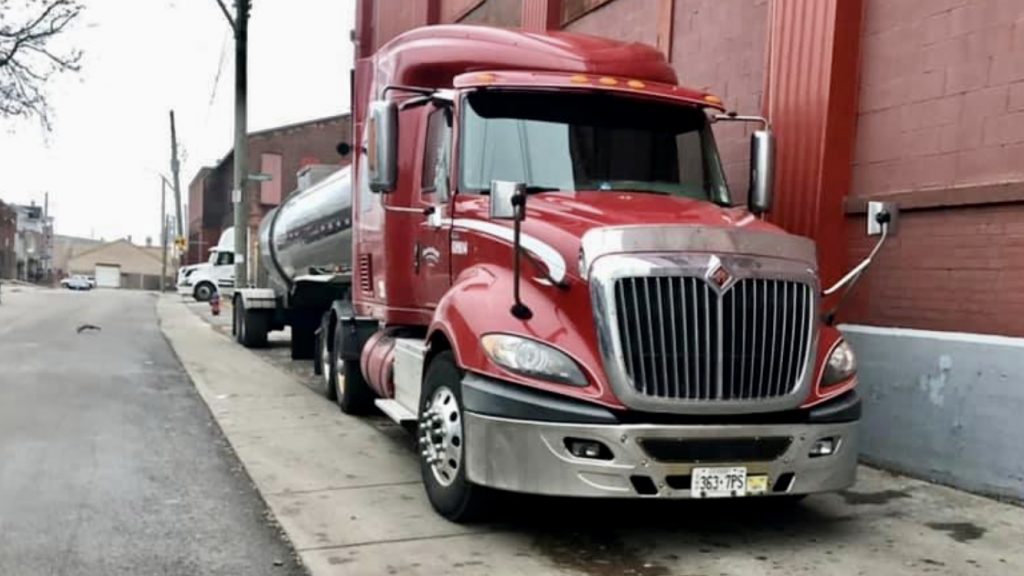
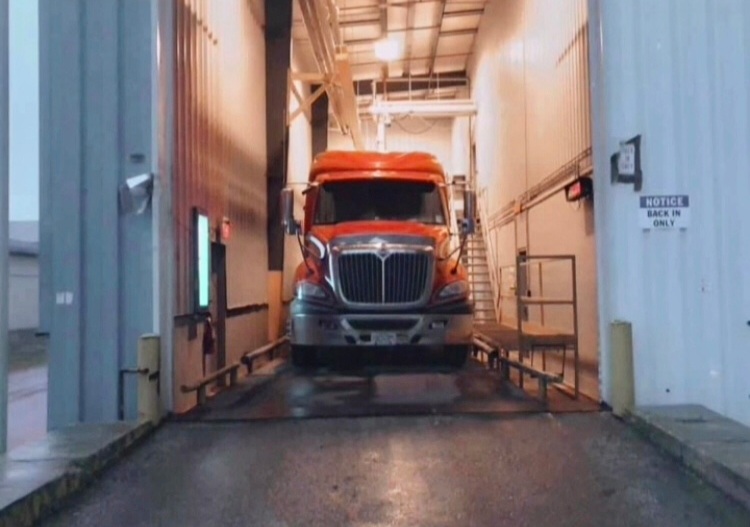
I’ve included a couple of pictures of some of my proud backing moments, a parallel park I have to do at one of my customers as it’s the only way to offload for them and a couple of me with my truck!!! Dana Allard
Message from Ryan Dierick – General Manager, Contrans Tank Group
Contrans Tank Group is proud to partner with the Women’s Trucking Federation on success stories like Dana Allard. Being a specialized tanker hauler, we see many drivers, especially new drivers, who are nervous about pulling a tanker because of the product handling that goes with the job. Dana’s success with Contrans Tank Group goes to show that with the proper training the tanker industry can be a great and rewarding job for all drivers. I personally cannot say enough good things about Dana and her work ethic at Contrans Tank Group, she is always pleasant with everyone she meets in her new career and a great addition to our company. I encourage others to follow in her footsteps and explore the rewarding and enjoyable jobs that the trucking industry can provide.
Message from Shelley Uvanile-Hesch CEO of the Women’s Trucking Federation of Canada
We would like to thank Philip Fletcher Commercial Heavy Equipment Training Ltd (CHET) and Musket Transport Ltd for donating this full scholarship to our scholarship program. We are proud to partner with Contrans Tank Group and thank you for your ongoing support of WTFC! It’s been a pleasure getting to know Dana and watch her grow in to her new career. Stay safe out there Dana!!
Looking to start your career as a Professional Driver reach out to CHET at http://www.chet.ca/
Are you a Professional Driver looking for a great company culture to work with? Reach out to Contrans Tank Group https://www.contranstankgroup.ca/
Truck drivers are not unique to working alone. However, in most industries work alone in the same environment. Drivers work alone in multiple environments and face tough challenges keeping themselves safe. There are several areas of risk, including driving. For now, I will focus on when the truck is stopped. Over the road Safety starts with a good pre-trip. This is not news to any professional truck driver. However, breaking down increases your exposure to the unknown. It’s important to ensure your vehicle is in top shape to keep you rolling.
Should you find yourself on the side of the road, here are a few Safety Tips. Keep your Side boxes locked. Don’t leave the side door release latch accessible. If you are approached by a person, who you did not call for help, do not exit the vehicle. Lock your doors. For Back up, turn your phone on to record the conversation. If the vehicle stops ahead, take a photo of the person, vehicle and license plate. Close your bunk curtains as they approach. This will provide the illusion there is another person with you. Do not disclose what is wrong with the vehicle or any load information. Tell them help is arriving imminently. Carry a basic tool kit, waterproof flashlight Carry two days of food and water Keep a travel toilet in the truck for places where you feel unsafe to leave the truck. Keep your curtains closed to give the illusion of a co-driver Keep your cell phone fully charged and within reach in the bunk. Never walk between trailers. Take the long way around. Carry flip flops, always wear them in the showers If you are concerned about security while sleeping, tie the driver and passenger door together with a ratchet strap.
In the Yard – Truck Stops, Rest Areas, Customers First and foremost, be aware of your surroundings. That may sound simple, but for a truck driver, it’s not. There are a lot of blind spots where risks can lurk. Here are a few questions to help evaluate your risk: What are my surroundings? Is the yard secured, or is there a guard? Is the ground level? Is there a tripping risk? Are there people in the yard? Are they employees? Know your work alone policy. Send a note to dispatch when you arrive at the facility. And when you leave. Call the customer ahead of time, ask if it is safe to park onsite. Is there security, driver facilities?
What can Companies do to keep their drivers safe? Well-lit yards. Provide facilities that lock – ie bathroom, showers Work alone policy. Use a check in AP or company communication device. Have a road buddy to keep in touch with – check in regularly. Keep notes on customer facilities. Rate their driver safety for reference. Use an Emergency response phone APP for drivers. Provide PPE for the job.
Deborah Gee
Deborah Gee is a CITT (CCLP) and RPR certified professional. Experienced class 1 driver with LTL, FTL and Heavy Haul. Deborah is currently a regional recruiter for Trimac Transportation in Calgary, Alberta. Deborah has been involved with WTFC since it’s inception and is on the board of directors. You can reach her at dgee@trimac.com
The Ministry of Transportation is committed to creating an environment for economic success for commercial vehicle clients through program efficiency, burden reduction, and engaging industry on opportunities to improve how our programs serve Ontario’s commercial vehicle industry.
As a result, the Ministry of Transportation has developed a new product for commercial vehicle clients called the “Online Carrier Record”. This new portal provides clients with instant access to all of their CVOR safety records in real time. Users will be able to filter and sort using a variety of functions and view these records online or download into a PDF or Excel file to help manage their safety performance.
You will have full access to the service and all your CVOR safety records.Access will be granted based on the email provided on the CVOR record.The service will be available for use 24/7.There will be no fee associated with this service.
Please note that in order to access this service, your email address must be listed on the CVOR file. If you need to update the record or have any questions or comments regarding the service, please contact Client Services by email CVOR@ontario.ca or by phone 1-800-387-7736.
(TORONTO, May 18, 2021) — The Canadian Trucking Alliance (CTA) continues to work with the Canada Border Services Agency (CBSA) and the Public Health Agency of Canada (PHAC) to boost electronic uptake of ArriveCAN within the industry.
As CTA recently reported, electronic uptake of ArriveCAN by commercial truck drivers (via the app or webpage) crossing the border into Canada was about 12 percent. Recent data obtained from the CBSA shows a stagnation of these numbers, with the potential for regression if greater awareness and increased compliance with the requirement is not improved moving forward.
CTA is again reminding the trucking industry that the requirement to use ArriveCAN remains in effect for all border crossers. Truck drivers who do not comply with the mandate at Canadian ports of entry may be issued significant fines by PHAC or other law enforcement organizations who have the ability to enforce the Quarantine Act. The verbal declaration to a Border Services Officer is only a temporary measure to allow the trucking industry to transition to the electronic ArriveCAN platform.
ArriveCan data can be submitted 72 hours in advance of cross border travel, allowing for greater flexibility in meeting this requirement.
The Government of Canada has also stated its intent to align with the European Union and other nations on the use of digital proof of vaccination to allow greater mobility for international travellers, while ensuring public health remains the top priority. Although the use of ArriveCAN to digitally store and present proof of vaccination has been mentioned by federal officials, no formal announcement has been made yet regarding the use of “vaccine passports” or its potential implications on travellers, such as truck drivers.
In order to assist companies in training their drivers to use the ArriveCAN app, CTA created a training package in both official languages which includes a tutorial video, infographic on how to use the app, and FAQ document.
The Government of Canada continues to explore methods to ensure compliance with ArriveCAN remains as seamless as possible. CTA will continue to update members on any changes to this policy and any future requirements as the information becomes available.